

ACRA Registered Business Address in Singapore: Home Address vs Virtual Office Address
Starting a business in Singapore seems simple until you reach the “registered address” section. Many founders assume they can use their home address. However,ACRA has specific requirements, and using a residential address requires extra approvals.
This guide clarifies common misunderstandings and walks you through the two main address options: your home address or a virtual business address.
What ACRA means by “registered office address”
ACRA requires every local company to provide aregistered office address during incorporation. This address is where official notices and communications get sent, and it’s also where the company’s registers and records are kept.
Importantly, ACRA also requires the registered office to be open and accessible to the public for at least three hours during ordinary business hours on each business day (excluding weekends and public holidays).
The “3-hour rule” ensures that legal documents can be served and your office can be reached if necessary. ACRA states thatnon-compliance may result in fines of up toS$5,000.
Meanwhile, the registered office need not be your actual operating location. For example, your registered address can be in the CBD while your operations happen elsewhere.
Also, if your registered address changes, you must update ACRA within14 days from the effective date of change via BizFile.
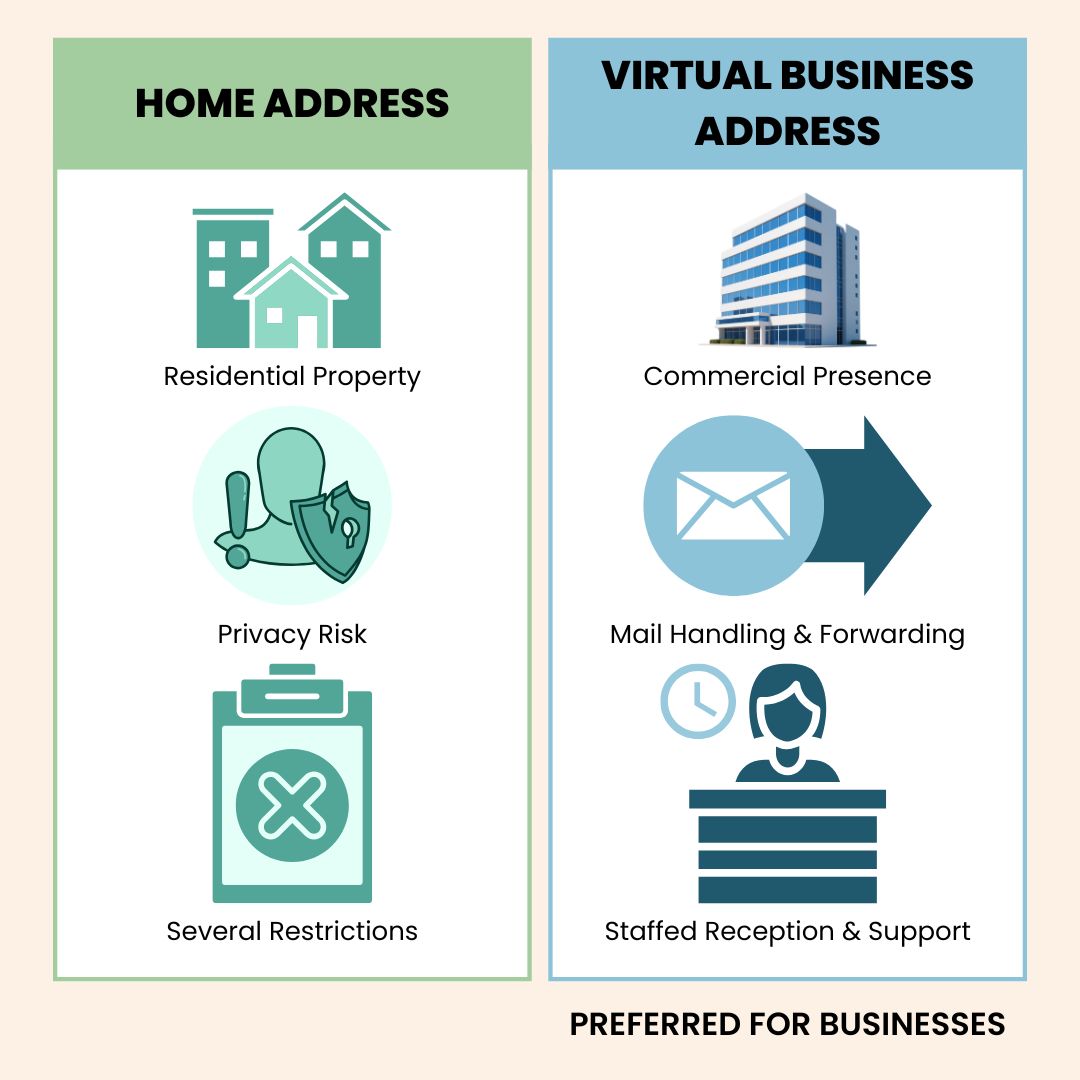
Option 1: Using your home address (what many founders miss)
You can use your home address in Singapore, but it isn’t always straightforward.
You usually need permission first (HDB or URA)
If you plan to run a small-scale business from home and use your residential address as the registered office, ACRA points you to theHome Office Scheme. HDB manages this scheme for HDB flats, and URA manages itfor private residential properties.
ACRA requires you to apply for Home Office Scheme approvalbefore submitting your company incorporation application.
Many miss this step and learn about the approval only after registering their business.
You usually need permission first (HDB or URA)
URA’s Home Office Scheme views home office use assmall-scale. It allows a private residence (or an HDB flat) to conduct a business’s administrative functions and employ up to 2 non-resident employees.
URA also lists key terms and conditions.For example:

The premises must remain primarily for residential use.

You may have at most two non-residents involved in the unit.

You must not cause disturbance to neighbours.

You must not display business signage outside the residential premises.
The 3-hour accessibility rule becomes your problem
Using your home address means you must comply with ACRA’s accessibility rule by ensuring someone is present for at least three hours on each business day. This works if you are home regularly, but it’s tricky if you have irregular hours or are often away.
Privacy: your address may be visible in public records
Using your home address can compromise privacy, as residential details may appear in public records when someone purchases entity information.
ACRA requires business owners to provide their residential address at registration, which means your home address may be included in public records accessible to anyone who purchases your entity information.
Fortunately, ACRA also allows you to register a contact address for public display instead of your residential address, provided it meets certain conditions (such as being located in Singapore and not being a P.O. box). This option lets you protect your home address from public disclosure.
Even with a virtual address, you may need a contact address strategy to protect officer privacy.
Option 2: Using a virtual business address (virtual office address)
A virtual business address provides a Singapore office location for your company’s registered address, often with mail handling and extra services.
This option is popular with:
-
- Freelancers who work remotely,
- Home-based founders who want privacy,
- Startups that want a more professional business presence.
Why virtual addresses fit ACRA’s registered address criteria
ACRA’s core requirements focus on “reachability” and “access.”
A staffed business centre address can simplify compliance because:
-
- The address is a physical Singapore location, and
- The office is usually open during business hours, so the “3-hour rule” is easier to meet.
Mail handling reduces the risk of missing important correspondence, as official notices go to your registered address.

Why founders choose virtual addresses, specifically
-
- Privacy: You avoid placing your home on your company’s “front door.”
- Professionalism: A commercial address can improve credibility in client conversations.
- Consistency: You can keep the same registered address even if you move house.
- Convenience: Someone receives mail while you focus on work.
Using a home address links your business identity to your personal location — a potential issue as your business grows.
Quick Comparison: Home Address vs Virtual Business Address
Choose a home address if:
- Your work is purely administrative and low-impact,
- You can meet the “3-hour accessibility” expectation,
- You can obtain Home Office Scheme approval first, and
- You are comfortable with the associated privacy trade-offs.
Choose a virtual business address if:
- You want a clear separation between your home and business,
- You want an address that stays stable as you move,
- You want a more professional public presence, and
- You want to minimise operational challenges related to mail receipt.
Common Mistakes to Avoid
- Registering first, then seeking approval
ACRA explicitly says to apply for Home Office Scheme approval before incorporation if you plan to use a residential address. - Ignoring the “3-hour rule”
ACRA requires accessibility for at least three hours on business days. - Forgetting to update address changes
Update changes within 14 days of the effective date. - Overlooking personal address exposure
Residential addresses may appear in public records, but registering a contact address is an option for those who prefer not to disclose their home address.

Conclusion: Pick the address that matches how you actually work
If you run a quiet, administrative home-based business, a residential registered address may suit you, provided you obtain the necessary approvals and remain compliant.
If you value privacy, flexibility, and a professional business presence, a virtual address is often a better option. It streamlines operations and meets ACRA’s requirements.
If you want an easier path, Lionsworld can help. Our Virtual Office Service provides a Singapore business address with professional mail handling, so you stay reachable without tying your business to your home.
Moreover, Lionsworld’s corporate services — incorporation, corporate secretarial support, and accounting — help you keep ACRA obligations on track as you grow. If you’re ready to register with confidence, this is a straightforward way to start compliant and stay consistent.
More From This Category

Side Hustle Bookkeeping Singapore: Simple Starter Guide
If you run a side hustle in Singapore — selling on Carousell, freelancing, or running a small online shop—it's easy to think: At tax time or when incorporating, PayNow screenshots pile up, personal expenses mix in, and you lose track of profits. Good news: you don’t...

Professional Front Desk Without Hiring
If you run a lean SME, you know hiring admin support early is risky, but seeming too small can also cost you clients, banks, or partners. Building a Professional Front Desk does not require hiring a receptionist. A system delivers the professionalism clients expect....
Side Hustle Bookkeeping Singapore: Simple Starter Guide
If you run a side hustle in Singapore — selling on Carousell, freelancing, or running a small online shop—it's easy to think: At tax time or when incorporating, PayNow screenshots pile up, personal expenses mix in, and you lose track of profits. Good news: you don’t...
0 Comments